 TALLYA
Printing · 7 min
How to print coloring pages
Two settings cause nearly every ruined printout — scaling and quality. The fix for each, the paper worth buying, and…
Most free printables are upscaled screenshots that print soft and grey. The five things to check before you spend paper, and where to get pages that survive a home printer.
Free printable mandalas are abundant and mostly disappointing, and the disappointment always shows up after you have spent the paper.
Here is what to check first. It takes about ten seconds and it is the same check whoever made the page.
1. Open it at 100% and look at a line. If the edges are soft or slightly furry, the image was upscaled from something small. A page that looks crisp in a thumbnail and soft at full size will print soft, and no printer setting fixes detail that is not in the file. For US Letter you want roughly 2550 × 3300 pixels, which is 300 DPI at 8.5 × 11 inches.
2. Check the margin. Home printers cannot print to the edge and will either crop or shrink the page. A printable designed for home use leaves about half an inch of clear space all round. Art that runs to the paper edge was made for a screen.
3. Check that regions close. Follow a line around one shape. If there is a gap — even a hairline — marker and ink will run straight through it and flood the neighbouring area. Closed line work is the single biggest difference between a page drawn for colouring and a picture that happens to be black and white.
4. Look at the centre. This is where cheap pages give themselves away. Radial designs get denser toward the middle, and if the line weight does not lighten to compensate, the centre turns into a grey mush of shapes too small for any pencil. Genuinely tiny regions are not detail; they are a design failure.
5. Ask what happens after twenty minutes. A page you can finish in ten is not restful, it is a warm-up. A page with no variation in scale gets tedious around the twenty-minute mark. You want large areas to move quickly through and small ones to slow down in.
Coloured pencil: standard 80 gsm copier paper is genuinely fine. Pencil does not soak, and cheap paper has a tooth that takes layers well.
Markers or fineliners: 80 gsm bleeds. Go to 120 gsm or more, and if you use alcohol markers put a spare sheet underneath, because they will go through almost anything.
Watercolour pencils: you need proper watercolour paper or the page will cockle into ridges the moment it gets damp. This is the one case where the paper matters more than the printer.
A growing share of free printables are generated rather than drawn, and they fail in ways that are easy to recognise once you know the tells. This is not snobbery — the failures are practical and they cost you paper.
Lines that do not close. The commonest one by far. A generated image is a picture of line art rather than actual line art, so strokes taper off and leave hairline gaps. Marker floods straight through them.
Detail that resolves into nothing. Zoom into a busy area. Real line work stays legible as objects — a petal, a leaf, a hinge. Generated work often dissolves into confident squiggles that look like detail at a distance and are meaningless up close, which is miserable to colour because there is no edge to work up to.
Line weight that ignores density. A drawn page lightens its lines as regions get smaller. A generated one keeps the same weight everywhere, so the middle fills in as a black clot.
Objects that do not survive being named. Point at a thing and say what it is. If you cannot — if it is a flower that is also a bird that is also a piece of ribbon — the page will not reward attention, because there is nothing in it to attend to.
The whole free-printable economy runs on volume. Pages are generated in batches, and the fastest way to make a mandala is to take one motif and rotate it — which is why so many of them look competent and feel like nothing.
There is no shame in a pattern. A pattern has no opinion, so no choice you make can be wrong, and on a tired evening that is exactly the right product. But it is worth noticing that you are choosing it, rather than assuming that a symmetrical drawing is all a mandala can be. Narrative mandala vs pattern mandala sets out the difference and what each is genuinely good for.
Every page in our library is a narrative mandala: the same radial architecture, filled with nameable objects — a door, a key, a lit window, an ivy taking a gate apart — arranged so that reading from the rim inward follows an order.
Practically, they are built to the checks above:
Nine books, 360 pages: dark botanical, dark folklore, storybook dwellings, flowers and their meanings, shadow patterns, quiet-evening pages. Three are free with an email, and the rest are in the printed books.
Browse them at the library. If your printer has been cropping or washing out pages, how to print coloring pages covers the two settings responsible for nearly all of it.
Every page in the library is a narrative mandala printed with its own reading — what the objects are, where they sit, and what the arrangement is doing. 300 DPI, US Letter, half-inch margin. Pick any three.
Choose my free pages See the booksWhat makes a good printable mandala coloring page?
Resolution high enough not to soften at full size, a real margin so a home printer does not crop it, closed line work so ink and marker do not bleed out of a region, and line weight that stays workable in the small areas near the centre.
What resolution should a printable coloring page be?
300 DPI at the size you intend to print. For US Letter that is roughly 2550 by 3300 pixels. A 1000-pixel-wide image blown up to a full page prints visibly soft, and no printer setting recovers detail that was never there.
Can I print coloring pages on normal paper?
Yes for pencils. Standard 80 gsm copier paper is fine for coloured pencil and takes it well. Markers bleed through it, so for those you want at least 120 gsm, and ideally a smooth cartridge or marker paper.
Are free printable mandalas worth printing?
Many are not, and the cost is your paper and ink rather than money. The check takes ten seconds: open the file at full size and look at whether the lines stay crisp and whether every region closes.
Two settings cause nearly every ruined printout — scaling and quality. The fix for each, the paper worth buying, and…
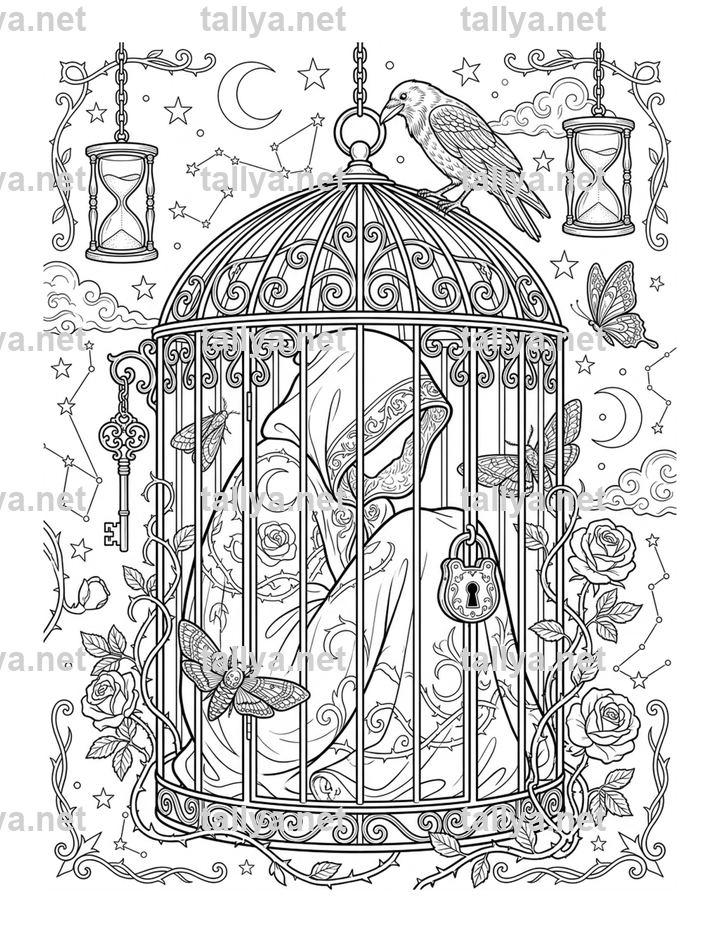
One is generated by a rule, the other composed by a decision. A side-by-side on how each is built, what each is good…
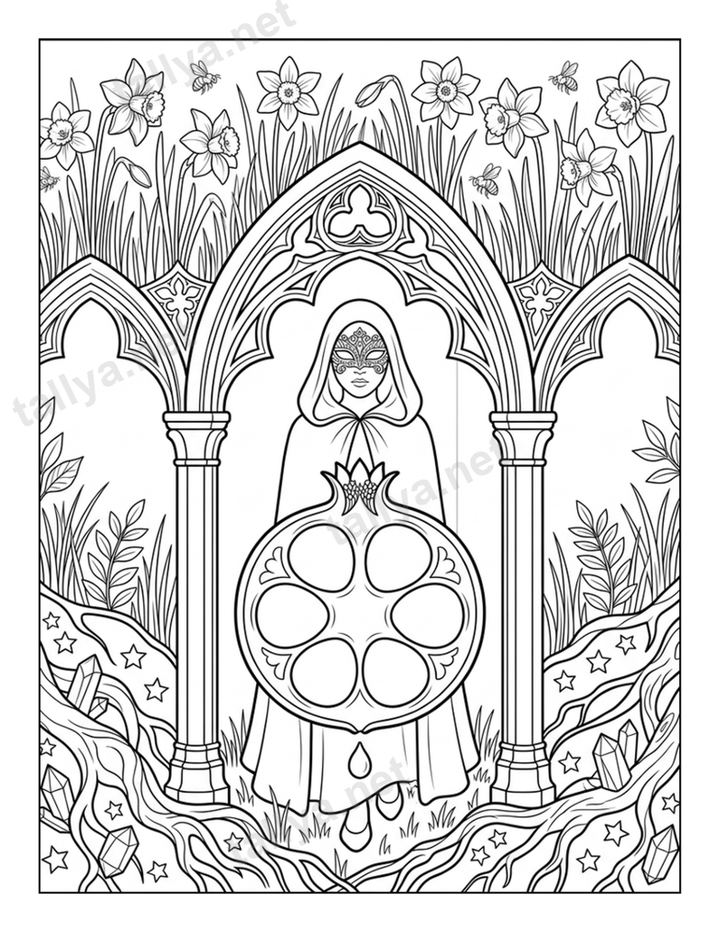
A narrative mandala keeps the circle and symmetry of a traditional mandala but fills them with nameable objects,…