 TALLYA
Prompts · 10 min
Shadow work prompts
Thirty questions built around the reactions you would rather not explain, grouped by the shape they point at — plus…
Shadow work means getting acquainted with the parts of yourself you keep out of sight. Where the idea comes from, what it is not, and why it is easier to look at drawn than described.
Shadow work is the practice of getting acquainted with the parts of yourself you keep out of sight. Not fixing them. Not forgiving them. Acquainting yourself with them, which turns out to be harder and more interesting than either.
The phrase has been through the internet a few times and come out inflated, so it is worth stripping back to what it actually meant and what can honestly be claimed for it.
Carl Jung used shadow for everything a person has pushed outside their own self-image. Not evil — unclaimed. The shadow holds the traits you would not list if someone asked you to describe yourself, and it fills up in a very ordinary way: a child works out which reactions get approval and which get trouble, and files the second set somewhere out of sight. Most of the filing is done before anyone can remember doing it.
Jung's sharper observation is the useful one: what is in the shadow does not go quiet. It comes back as a reaction to other people. The colleague whose confidence you find unbearable, the relative whose neediness makes you cold, the stranger whose showing-off you cannot stop thinking about — the intensity is the tell. Ordinary dislike is boring and passes. Disproportionate dislike is usually pointing at something.
That mechanism is what gave the term its afterlife. Whatever you think of Jung's larger system, the observation that we are hardest on the traits we have disowned survives contact with everyday life.
It is not self-improvement. Self-improvement wants to swap a trait for a better one. Shadow work only asks you to admit the trait is yours. Whether it then changes is a separate question, and the practice makes no promise about it.
It is not confession, and it is not penance. Feeling bad about something is not the same as looking at it. A great deal of what circulates online as shadow work is elaborate self-reproach, which is more comfortable than it looks — reproach keeps you the judge, and the judge is not in the shadow.
It is not clinical care. It is a way of paying attention, closer to keeping a journal than to anything a professional does, and it should not be sold as more. If something surfaces that you cannot set down again, that is exactly the point to talk to someone qualified rather than to a book.
And it is not a personality quiz. The categories are useful for finding a door. Which door is yours is not decided by a list.
The odd thing about the shadow is how few forms it takes. Across cultures and centuries the same handful keep turning up, which is why they are nameable at all.
None of these is a clinical label and none is unusual. They are common enough to be drawable, which is the whole reason a book of forty of them exists.
This is the part we can speak to directly, and the honest version of it is modest.
A description of a shadow arrives as a sentence about you, and sentences about you are argued with instantly. That is what the mind does with them. A drawing arrives as a thing on a table. It is not about you until you decide it is, and that half-second of distance is the whole trick — it is long enough to look before the arguing starts.
Then there is the hour. Colouring a page holds you next to an uncomfortable idea for sixty minutes without requiring you to do anything about it. Most reflection collapses because it is either instant or endless; an hour with a fixed edge is a rare shape.
That is the entire claim, and it is not a large one. The drawing does not do the work. It gives the work somewhere to sit.
Each page in Forty Shadows takes one of these patterns and builds it as a narrative mandala: a radial composition whose objects are chosen for what they mean, arranged so that reading from the rim inward follows an order. The rim states the situation, the middle band is what stands between you and it, and the centre is the thing being protected.
Read that way, the page makes an argument without writing a sentence about you. How to read a mandala is the ten-minute method, and shadow work prompts is the question set that goes with it.
Three of the pages are free. Start with a title that means nothing to you rather than the one that made you flinch — the flinch will still be there next week, and the neutral page teaches you the reading first.
Every page in the library is a narrative mandala printed with its own reading — what the objects are, where they sit, and what the arrangement is doing. 300 DPI, US Letter, half-inch margin. Pick any three.
Choose my free pages See the booksWhat is shadow work?
Shadow work is the practice of getting acquainted with the parts of yourself you keep out of sight — the reactions, wants and traits you would rather not claim. The term comes from Carl Jung, who used shadow for everything a person has pushed outside their own self-image.
Is shadow work the same as self-improvement?
Not really, and the difference matters. Self-improvement wants to replace a trait with a better one. Shadow work only asks you to admit the trait is yours. Whether anything changes afterwards is a separate question the practice does not promise to answer.
Is shadow work safe to do alone?
For most people, noticing and naming is ordinary reflection and carries no more weight than keeping a journal. It is not clinical care and not a substitute for a qualified professional. If something surfaces that you cannot set down again, that is the point to talk to one.
How does coloring relate to shadow work?
Only as a way of holding still. A drawing gives an uncomfortable idea a place to sit outside your head, and colouring it takes an hour of quiet attention. That is a container, not a method, and it is worth being honest that the difference is small.
Thirty questions built around the reactions you would rather not explain, grouped by the shape they point at — plus…
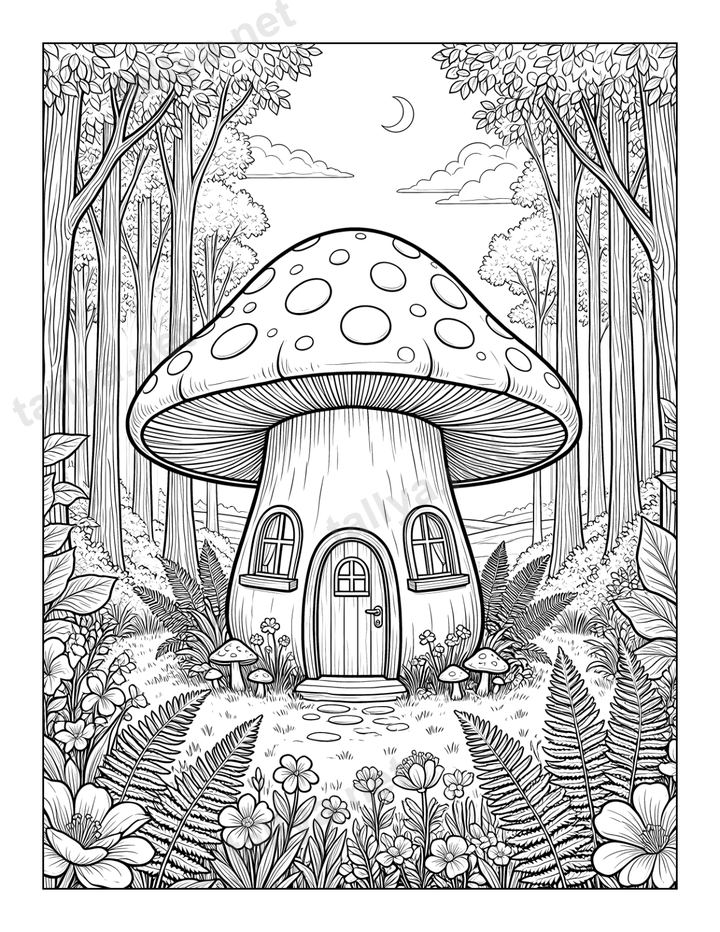
A three-step method for reading a symbolic mandala: name what you see, notice what stands between you and the middle,…
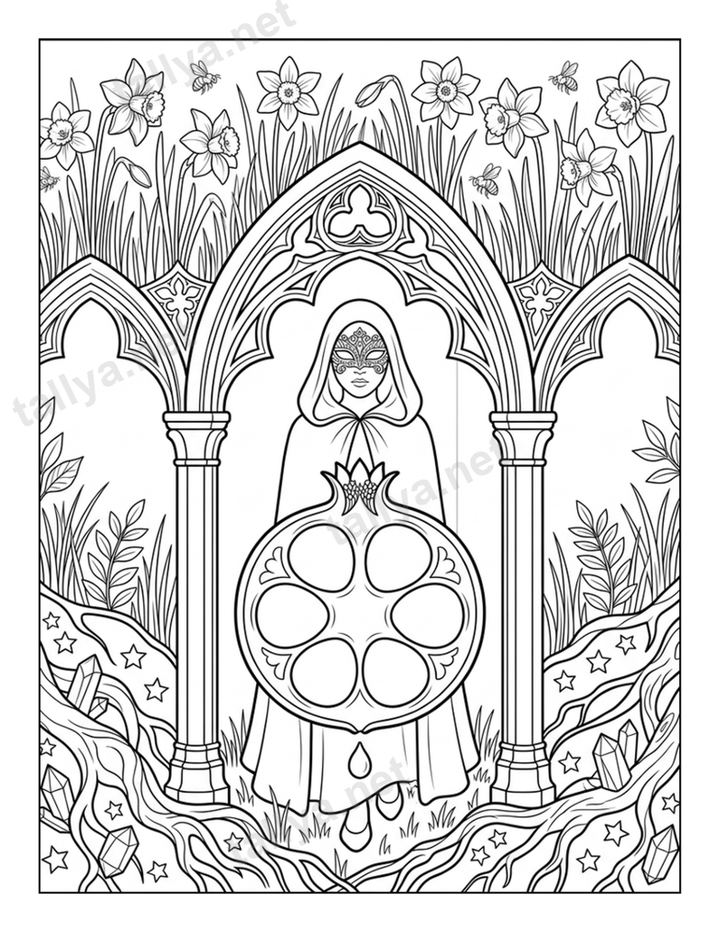
A narrative mandala keeps the circle and symmetry of a traditional mandala but fills them with nameable objects,…